

News
Monday, December 1, 2025
Version 3 of the AI-READI Dataset is Released

🚀 AI-READI Dataset v3 is Out
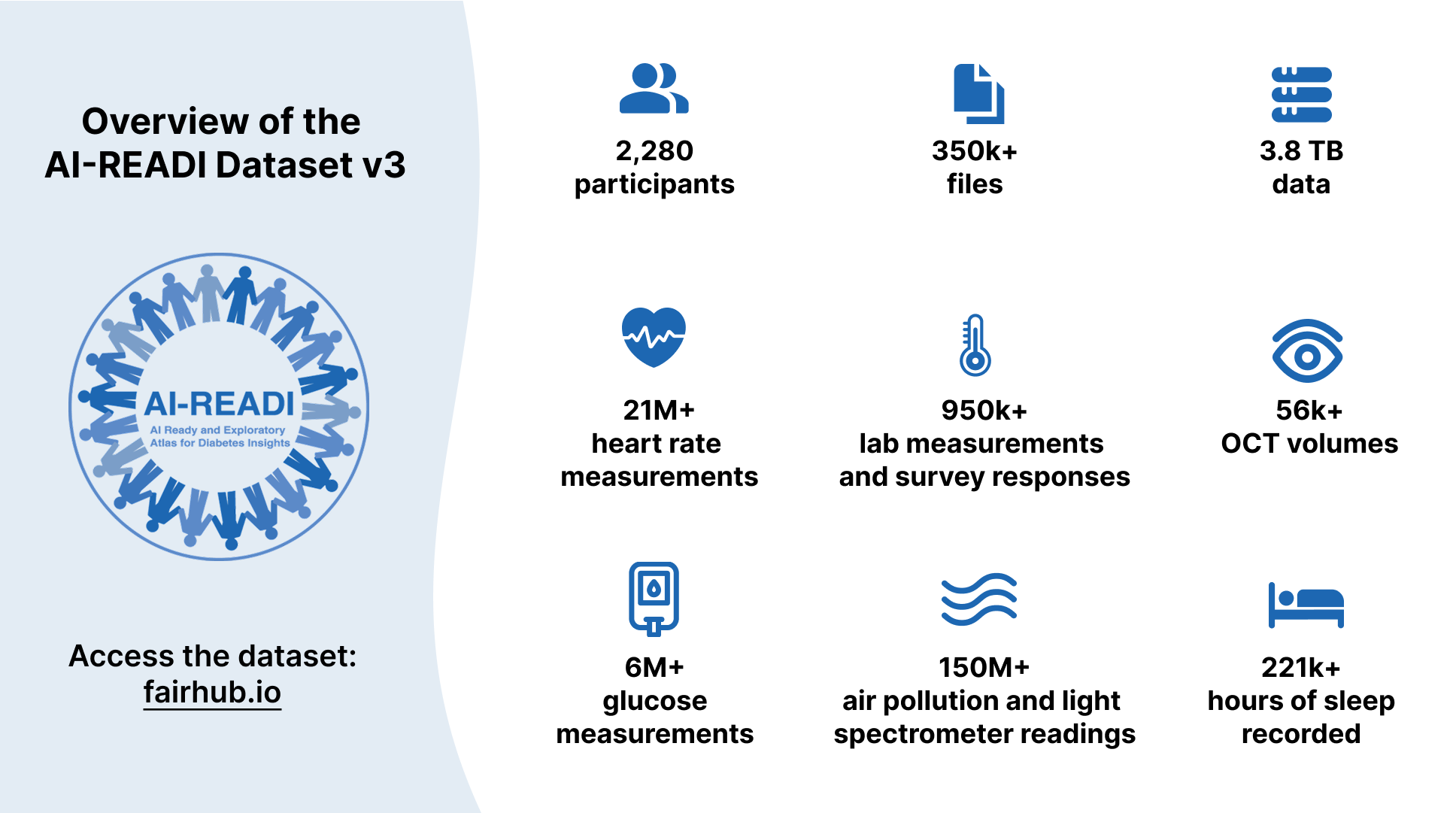
We are excited to announce the release of v3 of the AI-READI dataset. It is now available for access through FAIRhub at https://doi.org/10.60775/fairhub.3. This release includes 350k+ files (3.8 TB) of data from 2,280 participants, expanding the breadth and depth of multimodal data available to researchers working to uncover new insights into Type 2 Diabetes.
On popular request, we have also released a mini-version of the dataset with data from 100 participants (180 GB, <16k files) that we encourage users to download first to understand the data and set up their pipelines before downloading the full dataset: https://doi.org/10.60775/fairhub.4.
✨ What’s New in v3
This release adds major new content and improvements aimed at making the dataset more impactful and easier to use:
- Heidelberg Spectralis OCTA data on all participants
- Segmentation of B-scans on Topcon Maestro2, Topcon Triton, Zeiss Cirrus, Heidelberg Spectralis
- A new scalable dissemination method using Azure storage containers, enabling improved data delivery and access
🔗Accessing the Dataset and Resources
- Dataset access (request via FAIRhub): https://fairhub.io
- Documentation: https://docs.aireadi.org/
- Example Jupyter notebooks: https://github.com/AI-READI/ai-readi-notebooks
- PyTorch MONAI–compatible dataloader: https://github.com/AI-READI/aireadi_loader
ℹ️ About AI-READI
AI-READI (Artificial Intelligence Ready and Equitable Atlas for Diabetes Insights) is one of the Data-Generating Projects funded by Bridge2AI, an NIH Common Fund program designed to accelerate the use of AI in solving pressing challenges in human health. Using Type 2 diabetes as its model disease, AI-READI aims to collect multimodal data from 4,000 participants. To ensure the dataset is population-representative, enrollment is designed to balance participants across disease severity, race/ethnicity, and sex. The project collects diverse clinical data modalities, including vitals, electrocardiograms, glucose monitoring, physical activity, ophthalmic evaluation, and more, to enable broad reuse by the research community. The study is specifically designed to support novel discoveries in the salutogenesis of Type 2 diabetes, i.e., how and why someone with diabetes evolves toward health.
🛠️ Role of the FAIR Data Innovations Hub
Our team at the FAIR Data Innovations Hub contributes to multiple aspects of AI-READI, including:
- Co-leading the development of FAIRhub, a platform for managing, preparing, and sharing FAIR and AI-ready clinical research datasets
- Developing standards and guidelines for making clinical research datasets FAIR and AI-ready, including the Clinical Dataset Structure (CDS), recommendations for AI-ready datasets, and improved dataset documentation approaches (Datasheet-like methods)
- Developing and maintaining the project website (https://aireadi.org) and the documentation website (https://docs.aireadi.org)
- Supporting workforce development through mentoring interns in the AI-ready internship program
🤝 Funding and Collaborations
This project is supported by the National Institutes of Health (OT2OD032644). In addition to the FAIR Data Innovations Hub (California Medical Innovations Institute), the AI-READI Consortium includes teams from the following institutions:
- Johns Hopkins University
- Native Biodata Consortium
- Oregon Health & Science University
- Stanford University
- University of Washington School of Medicine
- University of Alabama at Birmingham
- University of California, San Diego
- Washington University in Saint Louis
📢 Disclosures
This post was written with help from ChatGPT.